May 5, 2026 • Declan Marsh • 10 min reading time • Prices verified June 11, 2026
Camera Tripods: What You Actually Need vs. What the Spec Sheet Sells You
A tripod is exactly what it sounds like — a three-legged stand that holds your camera steady so you can shoot without blur caused by hand movement, work in low light without cranking the ISO (the sensor’s sensitivity setting) to noisy extremes, or lock off a composition while you adjust lighting. Most photographers buy their first tripod quickly, for a specific urgent need, and deeply regret it within a year. The second tripod purchase is almost always smarter — but it’s also more expensive, because you’ve learned what cheap actually costs you. This guide is built to get you to that smarter decision the first time, or to validate what’s nagging you about the support system you’re already using. We’ll cover what the rated load capacity numbers actually mean, why carbon fiber’s price premium is sometimes justified and sometimes not, and the head-and-body pairing question that most buyers ignore until it’s too late.
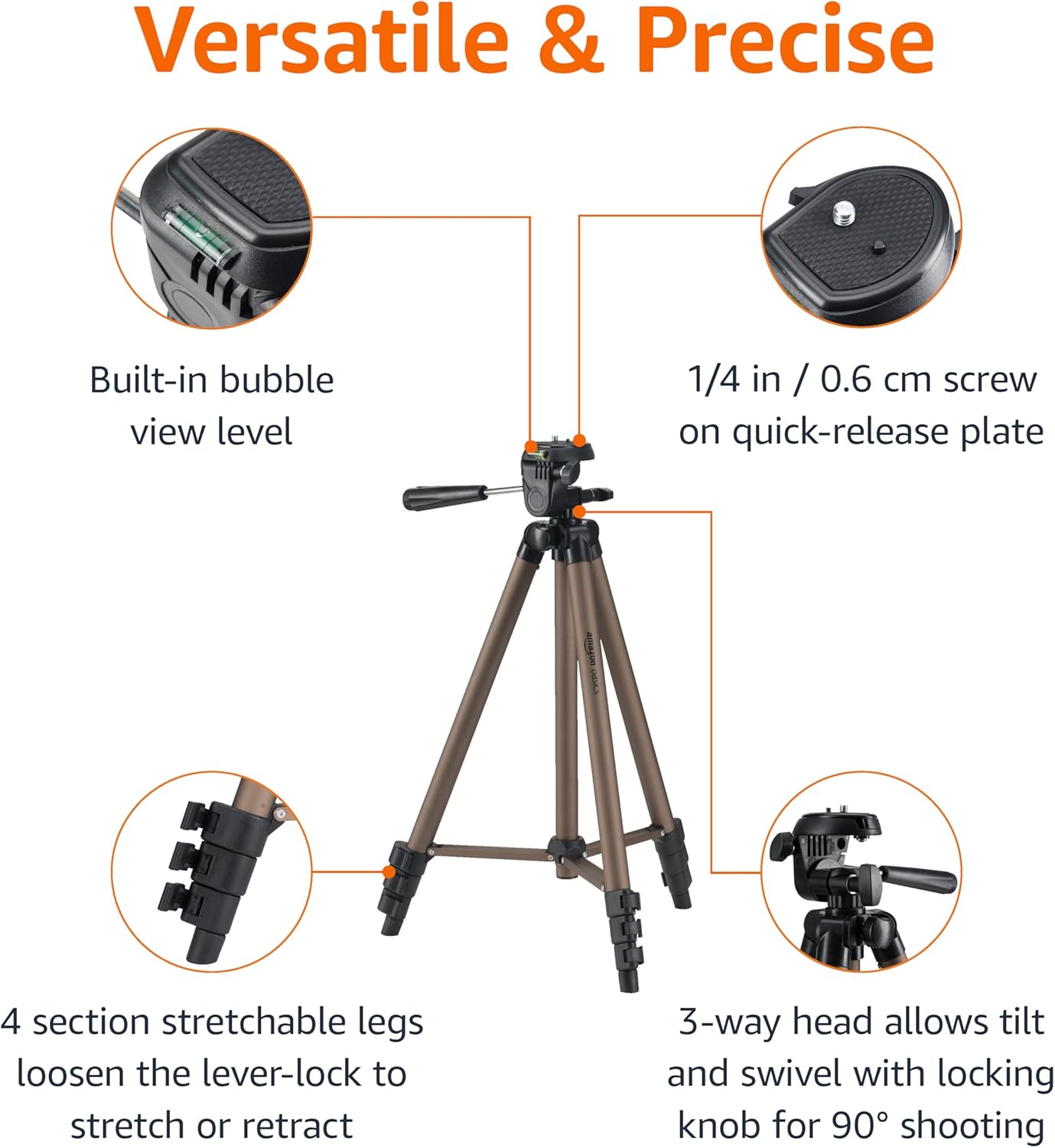
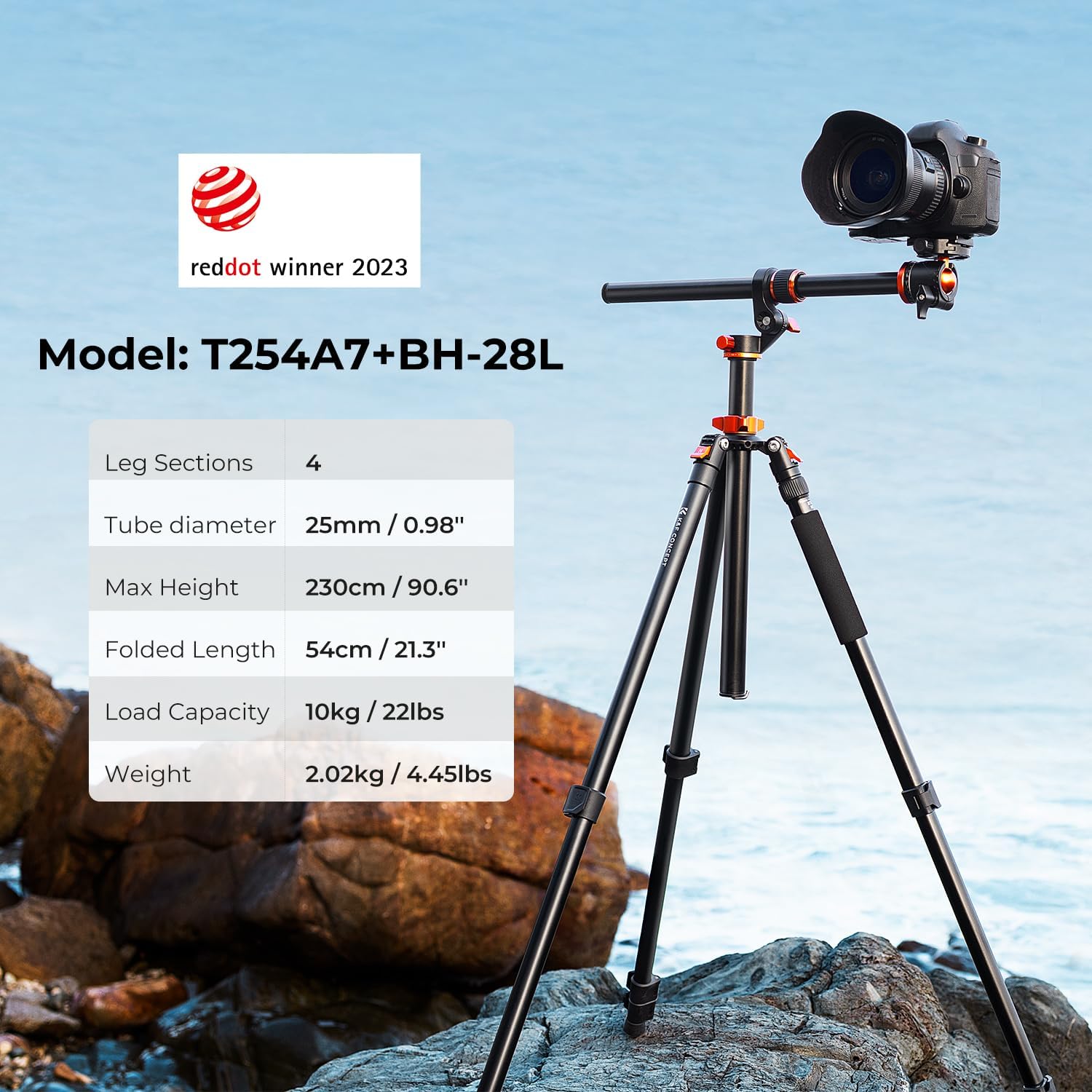
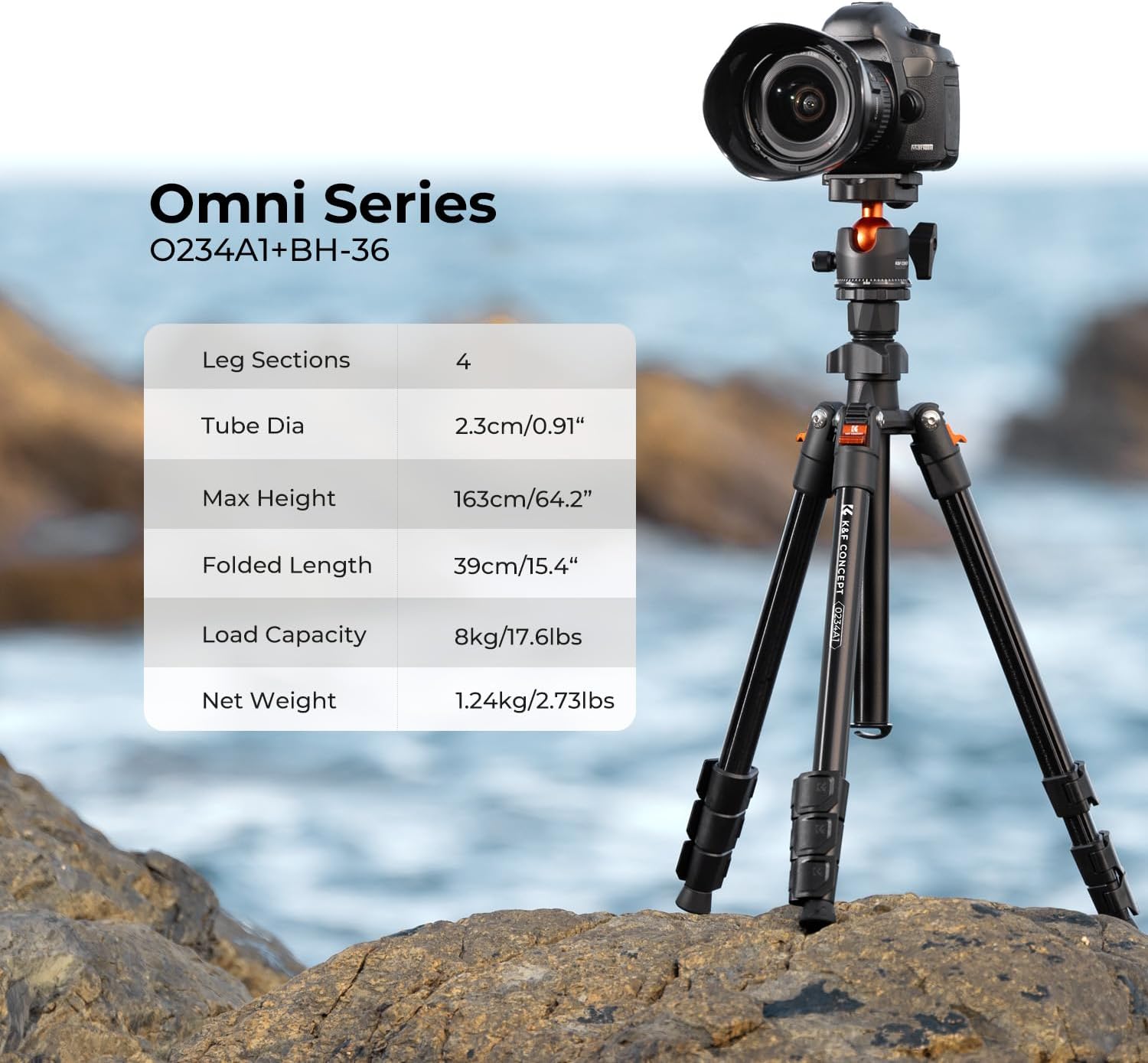
| EDITOR'S PICKK&F CONCEPT 90''/230cm Ultra Hi… | Mid-tierK&F CONCEPT 64 inch/163 cm Came… | Budget pick[Amazon Basics 50-inch Lightweig](https://www.amazon.com/dp/B0DZ5GJ9VC?tag=greenflower20-20)… | |
|---|---|---|---|
| Max Height | 90'' / 230cm | 64 in / 163 cm | 50 in |
| Load Capacity | 10 kg | 17.6 lbs / 8 kg | — |
| Ball Head | Yes | Yes | — |
| Monopod Mode | Yes | — | — |
| Horizontal Overhead | Yes | — | — |
| Price | $99.99 | $49.99 | $17.99 |
| See on Amazon → | See on Amazon → | See on Amazon → |
The Load Capacity Number Is Lying to You (Sort Of)
The payload rating on a tripod — typically expressed in kilograms or pounds, printed prominently on the box — is the single most misunderstood spec in this category. Manufacturers derive that number under optimal conditions: legs fully extended, center column retracted, weight distributed perfectly at the collar. It is a structural safety rating, not a “shoots sharp at this weight” rating.
Photography Life, in their guide “How to Choose a Tripod,” makes this distinction clearly: a tripod rated for 10 kg can hold 10 kg without collapsing, but it will vibrate — sometimes significantly — at loads well below that ceiling, especially when the center column is raised or a longer lens creates a lever-arm effect. The practical rule that experienced shooters and rental houses apply is to load a tripod to no more than 50–60% of its rated maximum if you want reliable sharpness at slow shutter speeds.
What this means in practice:
| Your kit weight | Minimum rated payload to target |
|---|---|
| Mirrorless body + 24–70mm f/2.8 (~1.8 kg) | 4 kg rated minimum |
| DSLR + 70–200mm f/2.8 (~3.2 kg) | 6–7 kg rated minimum |
| Medium format body + 110mm prime (~4.5 kg) | 9–10 kg rated minimum |
| Cinema rig with cage and follow focus (~5–8 kg) | 12–16 kg rated minimum |
Lensrentals, in their published analysis “Tripod Failure and What We’ve Learned From It,” reinforces this: the legs and collar rarely fail — it’s the head, the center column lock, and the leg-lock levers that show damage from operating close to the rated ceiling under field conditions. If you’re running a kit that gets transported frequently, the 50% rule isn’t conservative — it’s baseline maintenance practice.
Carbon Fiber vs. Aluminum: Where the Price Premium Actually Goes
This debate gets oversimplified constantly. The short version most people hear is “carbon fiber is lighter and doesn’t conduct cold.” That’s accurate but incomplete, and it obscures the cases where aluminum is the smarter buy.
Outdoor Photographer, in their feature “Carbon Fiber vs. Aluminum Tripods,” breaks down the practical differences: carbon fiber tubes dampen vibration faster than aluminum — this is measurable and meaningful for macro photography or telephoto work where any resonance in the legs translates directly to image softness. Aluminum rings like a tuning fork; carbon fiber damps. For portrait photographers shooting at 85mm or wider, a well-built aluminum tripod from a quality manufacturer will deliver equivalent sharpness at meaningfully less cost.
Carbon Fiber: When the Premium Is Justified
Carbon fiber justifies its price gap in three specific scenarios. First, travel and long hikes: a quality carbon fiber travel tripod can weigh under 1.3 kg, while an aluminum equivalent typically runs 1.8–2.2 kg. That weight delta is irrelevant on a studio floor and very meaningful at mile 8 of a trail. Second, cold-weather shooting: aluminum conducts cold aggressively, and bare-hand contact with an aluminum tripod at -15°C slows your workflow — carbon fiber is thermally neutral. Third, telephoto and macro work: the vibration-damping difference is real at 300mm and beyond, with wildlife and macro photographers consistently reporting noticeably sharper results with carbon fiber legs when shooting at the edge of motion tolerance. The Phoblographer, in their roundup “Best Tripods for Every Budget and Shooting Style,” specifically calls out carbon fiber as the recommended material for telephoto wildlife use cases where field portability and vibration control overlap.
K&F
$99.99
In stock on Amazon
Check price on AmazonAluminum: When It Is the Correct Choice
Studio work is the clearest case for aluminum. You are not carrying it far. Vibration at 50mm is a non-issue. Aluminum tripods in the $150–$200 range from established manufacturers like Manfrotto and Benro offer excellent build quality and payload ratings appropriate for most mirrorless and DSLR kits. Wirecutter, in their guide “The Best Tripods,” has consistently pointed to aluminum tripods in this price range as the recommended option for photographers who prioritize value in controlled environments.
High-abuse environments are another aluminum stronghold: wedding photographers shooting across multiple venues, photojournalists in crowd situations — aluminum dents where carbon fiber can crack. A dent is cosmetic; a crack is a failure. The Phoblographer’s tripod coverage also notes this durability advantage for event and run-and-gun shooters who trade polish for resilience.
K&F
$49.99
In stock on Amazon
Check price on AmazonBudget Tier: When to Prioritize the Head Over the Legs
Below the $150 leg threshold, the material question becomes secondary to build quality and leg-lock reliability. A mediocre carbon fiber tripod at $200 will underperform a well-built aluminum tripod at $150 on every metric that matters for most shooting scenarios — particularly leg-lock longevity and head-mount stability. At this tier, the smarter move is often to spend modestly on aluminum legs and redirect budget toward a better head, since the head determines the practical ceiling of what any leg set can deliver.
Photography Life’s “How to Choose a Tripod” frames it this way: an excellent head on adequate legs outperforms an adequate head on excellent legs for most still-photography workflows. If you are choosing between a $180 aluminum tripod with a good included ball head and a $180 carbon fiber tripod with a barely adequate head, buy the aluminum and the better head.
Amazon
$17.99
In stock on Amazon
Check price on AmazonThe Head Is the Tripod (and Most Buyers Get This Backwards)
Here is where most intermediate buyers leave real money on the table: they spend carefully on legs and then pair them with a head that limits what the legs can deliver — or vice versa.
There are three head types worth understanding for most shooting workflows.
Ball heads are the default for still photographers. A single knob locks a ball joint that lets the camera move in any direction before locking. They are fast, compact, and precise with quality build. The tradeoff is that under heavy loads, even a locked ball head can “creep” — the camera slowly droops as weight compresses the ball against the socket. The Phoblographer’s coverage of ball heads notes that creep becomes a consistent complaint in owner reviews for ball heads under $80. Above $150–$200, quality manufacturers largely eliminate creep through tighter tolerances and better materials.
Pan-tilt heads use separate controls for horizontal pan and vertical tilt. They are slower to operate but offer precise independent axis control — valuable for architectural work and any shooting that requires exact level horizon adjustment. Many studio and product photographers prefer them for exactly this reason.
Fluid video heads use hydraulic resistance to create smooth, drag-controlled movement — essential for video work. If moving shots are part of your deliverable, a ball head is the wrong tool. The drag system in a fluid head is what separates smooth professional pans from the stuttery movements that mark amateur video. Manfrotto’s 502 and 504 fluid heads are among the most-cited starting-point recommendations in videographer communities and rental-operator inventories, with a price range of approximately $200–$400 as of mid-2026.
The Arca-Swiss compatibility question is worth solving early. Arca-Swiss is a plate-and-clamp system — a broadly adopted standard for how the camera attaches to the head. Most quality heads now use Arca-Swiss compatible clamps. If yours does not, or if your L-bracket (an L-shaped plate that lets you mount the camera in both landscape and portrait orientation without removing it from the head) is not Arca-Swiss compatible, you are adding friction to every shoot. It is worth standardizing before you have built habits around the wrong system.
Rent Before You Buy at the $400+ Threshold
The decision calculus changes meaningfully above $400 total — legs plus head combined. Below that threshold, the used market and return windows are forgiving enough that a mistake is not catastrophic. Above it — and certainly in the $600–$1,200 range where serious carbon fiber tripods and quality fluid heads live — renting before committing is straightforward math.
Rental operators like Lensrentals carry high-end tripod systems. A weekend rental of a well-regarded carbon fiber travel tripod with a ball head typically runs $25–$40. If you are evaluating a $700 purchase, one rental gives you real shooting data on whether the height range works for your body, whether the leg locks suit your cold- or wet-environment workflow, and whether the head’s drag and clamp system fits your plate setup. That is a 5–6% due-diligence cost on a multi-year purchase — difficult to argue against.
Photography Life’s buying guide “How to Choose a Tripod” specifically flags this for travel tripods: the folded dimensions and packed weight of a travel tripod look equivalent on paper across several models, but the deployment ergonomics — how fast you can get it to full height, whether the leg angle locks are thumb-friendly with gloves on — only reveal themselves in use.
The “If X, Then Y” Decision Framework
Cut through the options with these decision rules:
If you shoot primarily stills in a studio or controlled environment: Aluminum legs plus a ball head or pan-tilt head, loaded to 50% of rated capacity. Spend the budget difference on the head rather than upgrading to carbon fiber legs you will not need.
If you travel with your kit more than twice a month: Carbon fiber legs are justified. Target 1.5 kg or less for the legs alone. The Gitzo Traveler series and Peak Design Travel Tripod are the benchmarks that reviewers at The Phoblographer and Photography Life return to consistently in this category.
If video is 30% or more of your deliverables: A fluid head is not optional. Budget $200 minimum for the head specifically, separate from the legs. Manfrotto’s 502 and 504 series are the documented starting point, with reliability histories across rental operators.
If you are shooting telephoto glass at 200mm or beyond outdoors: Carbon fiber legs, a high-quality ball head rated well above your load, and — critically — keep the center column down. The center column is a vibration amplifier. Both Lensrentals’ failure analysis and Photography Life’s “How to Choose a Tripod” identify center-column use as one of the most common sources of unexpected softness in tripod-based telephoto shooting.
If your total kit weight exceeds 4 kg: Move up a tripod category. The weight savings from undersizing legs are not worth the creep, vibration, and eventual failure risk documented in Lensrentals’ tripod failure reporting. Size up, use the center column as little as possible, and the system will outlast most of the cameras you mount on it.
The tripod you reach for every time is the right tripod. The one that stays in the car because it is too heavy, or stays home because it is too fragile for the environment, is a spec-sheet purchase. The math on buying it right the first time — even at twice the cost — nearly always closes before the second year.