April 29, 2026 • Declan Marsh • 9 min reading time • Prices verified June 11, 2026
Canon APS-C Mirrorless: What the R100, R50, and R7 Actually Cost You Out the Door
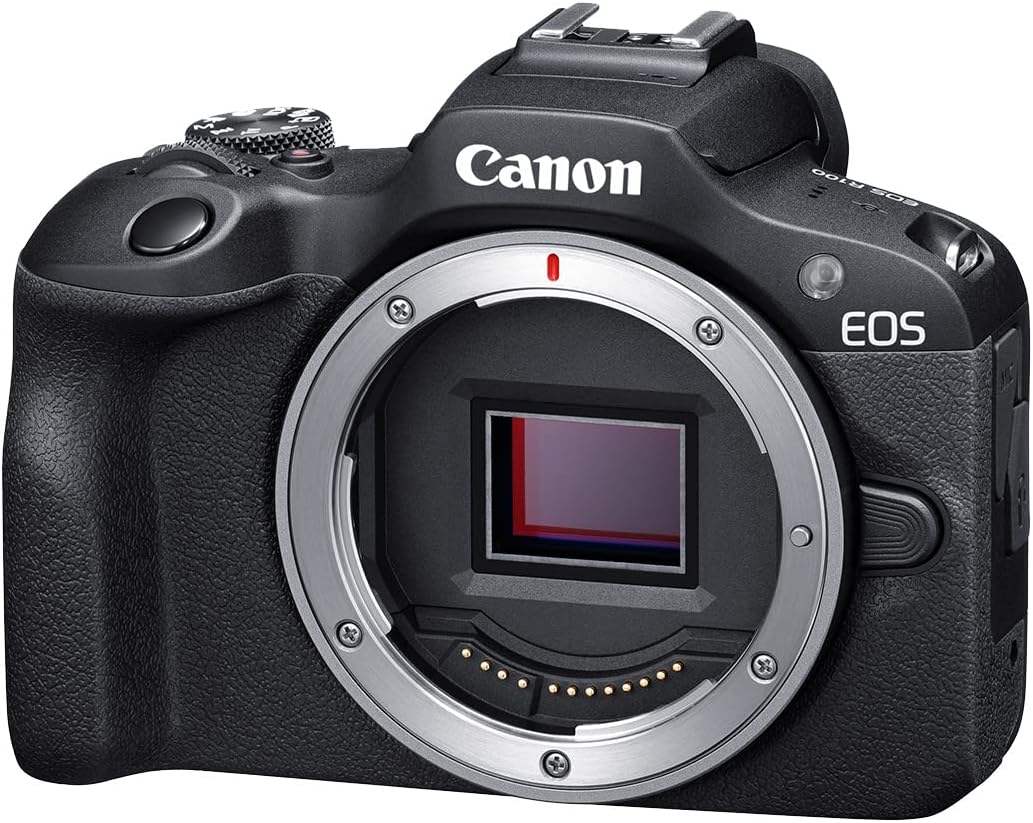
Canon’s mirrorless system uses a mount called RF (the bayonet — the physical ring where lens meets camera) on full-frame bodies, and a smaller variant called RF-S on its crop-sensor, or APS-C, cameras. APS-C means the sensor is roughly 60 percent the area of a full 35 mm frame, which makes the whole system lighter and cheaper but also changes how lenses behave: a 50 mm lens on APS-C frames more like an 80 mm lens would on full frame, because the smaller sensor “crops” the image circle. If none of that was in your vocabulary five minutes ago, no worries — this article will make it matter by the end.
The R100, R50, and R7 are Canon’s three current APS-C RF-mount bodies, sitting at roughly $480, $660, and $1,500 body-only as of mid-2026. They look like a tidy three-rung ladder. The problem is that the rungs aren’t evenly spaced once you factor in lenses, accessories, and the ecosystem traps built into each tier. This guide shows you the real out-the-door cost at each level, names the trade-offs explicitly, and ends with a clean decision rule so you can stop second-guessing the configuration and start shooting.
The Body Prices Are Only the Beginning
Canon’s current RF-S native lens lineup is still maturing. That’s the first thing any honest guide has to say, because it changes the math at every tier.
Right now the native RF-S catalog sits at around a dozen lenses — a few kit zooms, a macro, and the 55-210 mm telephoto. If you want wide primes, fast primes, or specialty glass you’re either renting, adapting EF lenses from Canon’s older DSLR system via the Canon EF-EOS R adapter ($99–$119 new), or reaching for full-frame RF glass at prices that quickly dwarf your body investment. That context is load-bearing for everything below.
Canon EOS R100 — Street price: ~$480 body-only; ~$580 with the RF-S 18-45 mm f/4.5–6.3 IS STM kit lens. This is the entry point, and DPReview’s Canon EOS R100 Review is honest about what “entry point” means here: no in-body image stabilization (IBIS), a single SD card slot, no top LCD, a fairly slow burst speed, and a rear dial layout that hobbyist users find limiting within six months. The sensor is a 24.1 MP APS-C chip that delivers solid results in daylight but softens meaningfully in low light compared to the R50’s sensor design.
A realistic starter kit for the R100 — body, kit lens, a second battery (Canon LP-E17, $45 third-party or $50) — lands you at $700–$750 out the door. That’s the minimum to walk out the door and not immediately be stuck.$70 OEM), a 128 GB SD card ($25), and a halfway-decent bag (
Canon EOS R50 — Street price: ~$660 body-only; ~$780 with the 18-45 mm kit. The R50 is where the APS-C Canon lineup genuinely starts making sense for an intermediate buyer. The Phoblographer’s Canon EOS R50 Review highlights the meaningful upgrade: a 24.2 MP sensor with better high-ISO performance than the R100, Canon’s Dual Pixel CMOS AF II (a much faster and more reliable autofocus system that tracks subjects using phase detection across nearly the full sensor), and electronic stabilization that cooperates with stabilized lenses for usable handheld video. Imaging Resource’s Canon EOS R50 Verdict calls the autofocus performance “class-leading” for the price tier.
A realistic R50 starter kit — body, 18-45 mm kit lens, second battery, fast SD card, bag — runs $950–$1,000 out the door. If you add the RF-S 55-210 mm f/5–7.1 IS STM (~$350) to have a meaningful telephoto reach, you’re at $1,300–$1,350. That’s the true two-lens kit cost.
Canon EOS R7 — Street price: ~$1,500 body-only. No kit lens configuration at this tier; Canon doesn’t bundle one. DPReview’s Canon EOS R7 Review and Photography Life’s Canon EOS R7 Long-Term Notes both land in the same place: this is the most capable APS-C body Canon has built to date — 32.5 MP, IBIS rated at up to 8 stops of stabilization when paired with an IS lens, two card slots (one CFexpress Type B and one SD/UHS-II), 30 fps electronic shutter, and a weather-sealed magnesium alloy body. The autofocus is the same system as the R3 and R5 at launch. For sports, wildlife, and working photographers who need reliability, the R7’s spec sheet is genuinely competitive with cameras that cost more.
But a working R7 kit requires investment proportional to the body. A two-lens setup — the RF-S 18-150 mm f/3.5–6.3 IS STM ($550) plus the RF 100-500 mm f/4.5–7.1 L IS USM ($2,700) for wildlife/sports reach — is already at $4,750 before a bag, cards, or batteries. Most R7 buyers building a serious kit will spend $2,500–$5,000+ total, depending on how deep into RF glass they go.
The Hidden Tax: Ecosystem Lock-In and Adapter Math
Here’s the trade-off Canon doesn’t advertise clearly: RF-S bodies sit inside a full-frame RF ecosystem, and Canon’s full-frame RF lenses are spectacular but priced accordingly. The 50 mm f/1.8 RF — the cheapest fast prime Canon offers — is ~$200 and is full-frame glass that works on APS-C bodies at a 1.6× crop (giving you an ~80 mm equivalent field of view). That’s actually fine for portraits, but it doesn’t solve wide-angle needs.
For wider primes on RF-S bodies, your main paths are:
- Adapt EF lenses via the Canon Mount Adapter EF-EOS R (~$99). Owners of legacy Canon glass find this works cleanly, and LensRentals’ Canon RF-S Lens Availability and Rental Data confirms the adapter maintains autofocus with most EF lenses. But you’re buying into a growing second system.
- Wait for third-party manufacturers — Sigma and Tamron have both confirmed RF-S mount lenses are in development, with a few options beginning to appear in 2025–2026. Prices will likely undercut Canon’s first-party options meaningfully.
- Buy full-frame RF glass and accept the premium. A Sigma 18-50 mm f/2.8 DC DN has been adapted to RF-S and runs ~$380; that’s the most affordable fast zoom solution for APS-C currently.
The practical upshot: if you’re buying an R100 or R50, budget $300–$600 in lens spend beyond the kit lens in the first 12 months if you’re serious about image quality. If you’re buying an R7, assume $1,500 minimum in lenses to unlock what the body is capable of delivering.
By the Numbers: True Kit Cost at Each Tier (Mid-2026 Pricing)
| Tier | Body | Minimum Functional Kit | Serious Two-Lens Kit |
|---|---|---|---|
| R100 | ~$480 | ~$750 | ~$1,100 |
| R50 | ~$660 | ~$1,000 | ~$1,350 |
| R7 | ~$1,500 | ~$2,100 | ~$3,200–$5,000+ |
Minimum functional kit = body + one zoom + second battery + storage. Serious two-lens kit adds a telephoto or fast prime. R7 serious kit assumes RF-S 18-150 + one quality telephoto or fast RF prime.
The Used and Rental Cases Worth Running
The R7 used market on MPB and KEH Camera is worth checking seriously before buying new. As of mid-2026, good-condition R7 bodies are appearing in the $1,050–$1,200 range — that’s 25–30% off new. Given that Photography Life’s long-term notes confirm the R7 is mechanically durable and that Canon’s RF mount is still relatively young (meaning used bodies have low actuations), the used case is unusually strong here. Saving $400–$500 on the body and redirecting it toward a better lens is the right move for most buyers.
For the R100 and R50, used savings are smaller (~$80–$130 off new) and the warranties matter more at this price point, so the used argument is weaker.
LensRentals’ rental data consistently shows the RF-S 55-210 mm and the RF 100-500 mm as high-availability rentals, which matters if you’re not sure you need telephoto reach regularly. Renting the 100-500 mm at ~$75–$90 for a weekend before committing $2,700 is the right call — the lens is genuinely excellent but its value is entirely dependent on whether you shoot subjects at distance.
Decision Rule: If X, Then Y
If you’re buying your first mirrorless camera and the budget ceiling is $800: The R50 with the 18-45 mm kit is the correct answer. The R100 saves you $180 but gives up Dual Pixel AF II and better high-ISO performance — two things you’ll feel within three months of regular shooting. Owners across aggregated reviews consistently name the autofocus gap as the reason they wish they’d stepped up. At $780 for the kit, the R50 is the better value.
If you already own EF lenses from a Canon DSLR and want to move to mirrorless: The R7 with the EF adapter is the transition body. You preserve your glass investment, gain IBIS and weather sealing, and get a body whose AF system is fast enough to keep pace with the lenses you’ve already paid for. The R50 at half the price is tempting, but if you own quality EF glass, the R7’s body capabilities will actually unlock it.
If you’re building a new kit from zero and can spend $2,500–$3,500 total: Spend $1,500 on the R7 body used (targeting $1,100–$1,200 on MPB or KEH), $550 on the RF-S 18-150 mm, and $700–$900 on a used or third-party fast prime. That’s a genuinely versatile, weather-sealed, high-resolution kit that you won’t outgrow for years.
If the primary use case is video and you’re budget-sensitive: The R50 oversamples 4K from its APS-C sensor and owners report the autofocus tracking in video is notably better than its price suggests. For hybrid shooters — stills and video — the R50 is the efficiency pick below $1,000. The R7 adds higher resolution and better stabilization but the video feature set doesn’t widen dramatically until you’re considering full-frame bodies.
If you’re not sure you’ll use a telephoto more than four or five times a year: Don’t buy the lens. Rent it. The math doesn’t support ownership below roughly six dedicated shooting trips annually at telephoto distances. LensRentals and local rental shops both stock the RF-S 55-210 mm and more powerful RF telephoto options at prices that make occasional rental obviously correct.
The Canon APS-C lineup is genuinely good at every tier in 2026 — but “genuinely good” is not the same as “genuinely right for your kit.” Run the real numbers before you click purchase.